Ecommerce AI discoverability, explained.
How shoppers find products through AI assistants, why most stores get skipped, and what to do about it. A plain-English explainer with sources for every claim.
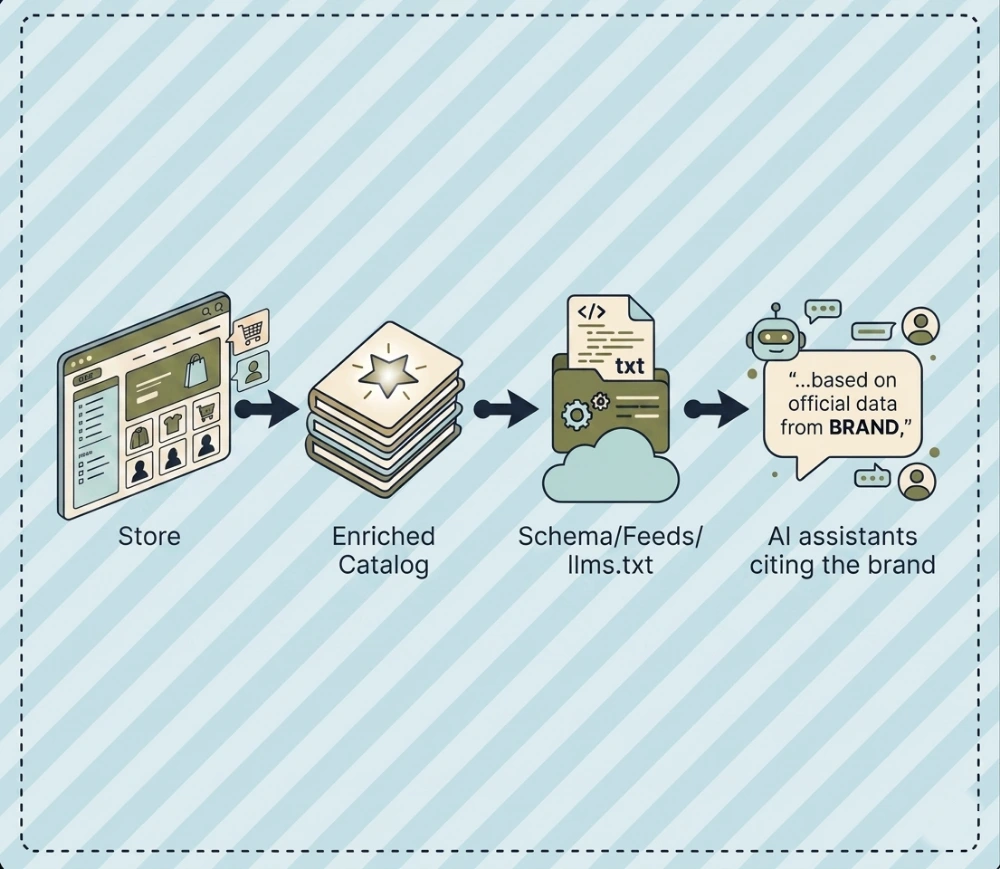

What is ecommerce AI discoverability?
It's how easily AI assistants like ChatGPT, Gemini, and Perplexity can find, understand, and recommend your products when shoppers ask what to buy. It depends on three things: how rich your product data is, how readable it is for machines, and how fresh it stays.
Around 77.6% of consumers worldwide shopped with AI in the past six months (Search Engine Land, April 2026), and roughly 50 million shopping questions are asked inside ChatGPT every day (OpenAI Economic Research, 2026), which makes AI discoverability a core acquisition channel.
What "AI discoverability" means
Plain version: can AI find your products, understand them well enough to recommend them, and cite you as the source. It's the AI-era counterpart to SEO and a separate discipline, because AI selects sources differently than Google ranks pages. The field is often called Generative Engine Optimization (GEO) or Answer Engine Optimization (AEO).
Why SEO doesn't cover it
AI assembles answers from sources it trusts and can read efficiently, and those frequently aren't your top-ranking pages.
This is a fast-growing channel your SEO dashboard can't see.
The four things that make AI recommend you
Each links to its capability page.
AI discoverability by industry
The principles are the same. The attributes that win each category aren't.
Where Swellpipe fits
Swellpipe handles all four at once and keeps them current, so AI has the best possible picture of your products. Monitoring tools show the gap; Swellpipe closes it.
FAQ
What's the difference between GEO, AEO, and AI discoverability?
Does AI discoverability replace SEO?
How do I know if AI can already find my products?
How long does it take to improve AI discoverability?
Be the answer AI gives shoppers.
Get in early. The closed beta is open.